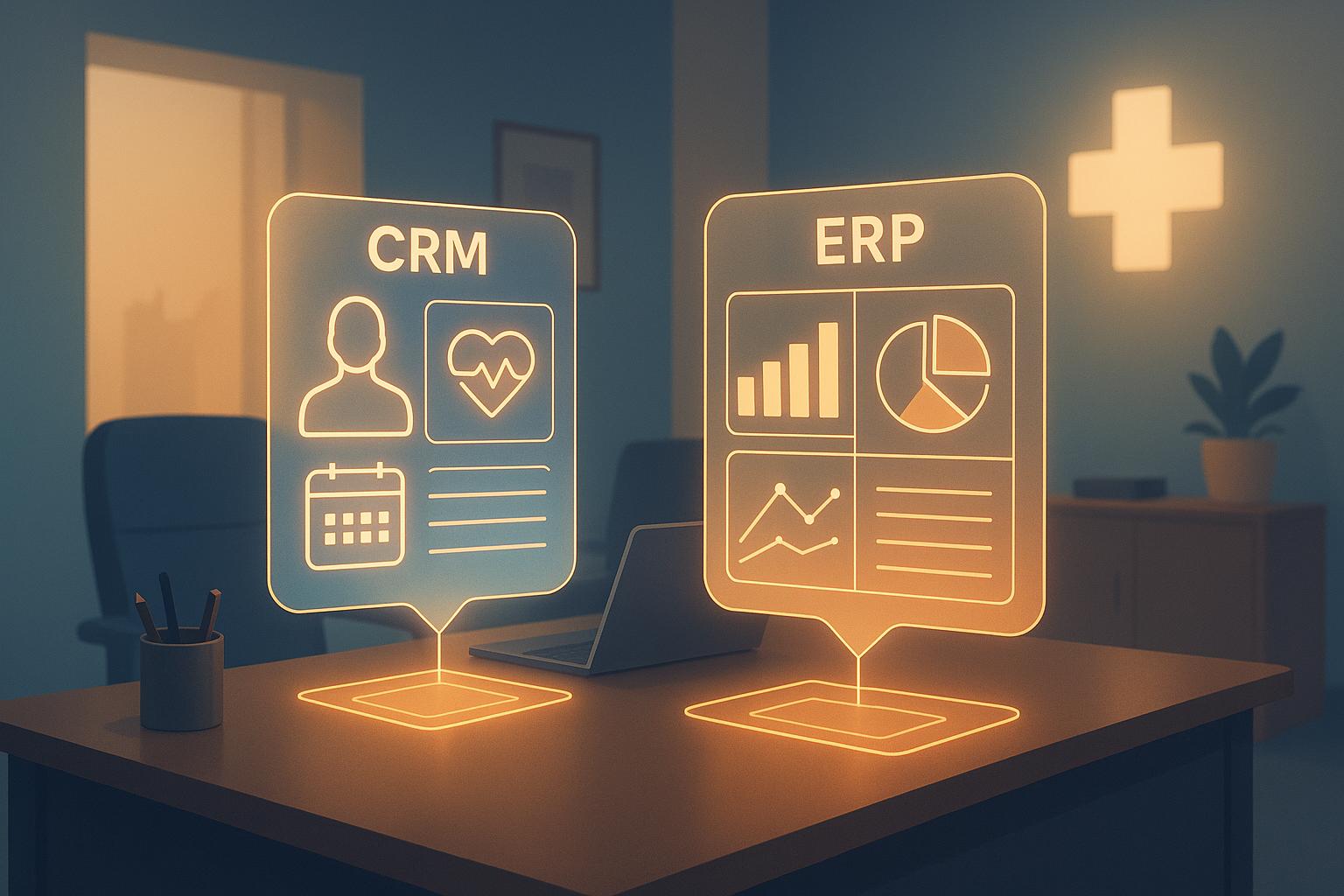
Integrating CRM and ERP systems can transform how healthcare organizations manage patient data. Here’s the key takeaway: CRM systems excel at managing patient interactions and communication, while ERP systems handle administrative tasks like finances, inventory, and compliance. Combining them eliminates inefficiencies, creating a unified solution for better decision-making and patient care.
Key Points:
- CRM Systems: Focus on patient engagement, scheduling, and communication workflows.
- ERP Systems: Manage financials, inventory, and back-office operations.
- Combined CRM-ERP: Connects front-office and back-office systems, providing a single source of truth for patient and operational data.
Benefits of Integration:
- Centralized Data: All patient and organizational information in one place – no silos.
- Automated Workflows: Streamlines tasks like scheduling, billing, and resource management.
- Improved Compliance: Simplifies meeting HIPAA and other regulatory requirements.
Who Should Use What?
- Smaller Practices: CRM-only systems for simpler patient management.
- Larger Organizations: ERP-only systems for complex operations.
- Growing Providers: Combined CRM-ERP solutions for scalability and efficiency.
Bottom Line: While CRM and ERP systems each have strengths, integrating them delivers long-term value by aligning patient care with operational processes. For healthcare providers ready to invest, this approach simplifies workflows and enhances overall performance.
1. CRM Systems Only
CRM-only systems focus on centralizing patient interactions but often fall short when it comes to managing all organizational data comprehensively.
Patient Data Centralization
CRM systems act as a central hub for managing patient interactions and relationship histories. They consolidate contact details, appointments, communication logs, and basic patient history. This setup works well for smaller practices that need to streamline how they handle patient touchpoints.
However, these systems can create data silos by leaving out billing, lab results, pharmacy records, and device data. This forces providers to rely on multiple systems to get a complete picture. While the centralization in CRMs supports automation and improves patient communication workflows, it doesn’t fully integrate all aspects of healthcare operations.
Workflow Automation
With centralized data, CRM systems simplify patient communication workflows. They automate processes like appointment reminders, follow-up messages, and engagement campaigns through text messages, emails, and surveys. This reduces manual effort and ensures consistent communication.
That said, CRM systems are less capable when it comes to automating clinical and administrative tasks, such as verifying insurance or managing medical supply orders. These areas typically require the advanced integration features found in ERP systems.
Regulatory Compliance
Maintaining HIPAA compliance in a CRM-only environment requires careful configuration and constant monitoring. Healthcare-focused CRMs often include features like access controls, audit trails, and data encryption to safeguard patient health information. Still, organizations must ensure staff are properly trained and that any data exchanges with non-integrated systems remain secure.
CRMs are effective at handling compliance for patient communication and consent management. They can track patient preferences and maintain consent records. However, when patient data moves between the CRM and other disconnected systems, compliance risks increase. This makes it essential to implement additional security measures at these touchpoints.
Operational Efficiency
CRM systems improve operational efficiency by automating routine tasks and reducing the need for manual data tracking. They give healthcare teams quick access to patient preferences, communication histories, and care coordination notes, enabling more personalized care.
However, these efficiency improvements are mostly limited to front-office tasks. Back-office functions like inventory management, financial operations, and resource planning still require manual effort. Combining CRM systems with ERP capabilities can bridge these gaps and provide a more comprehensive solution for healthcare organizations.
2. ERP Systems Only
ERP systems are excellent for managing back-office operations, but they fall short in addressing patient-centered engagement. While CRM systems focus on patient interactions, ERP systems excel in streamlining operational tasks, emphasizing the need for integrated solutions in healthcare.
Patient Data Centralization
ERP systems consolidate data into a unified database that integrates financial records, inventory, supply chain details, and administrative information. This comprehensive approach gives healthcare organizations a clear view of operational metrics, resource use, and cost management across various departments.
One of the standout features of ERP systems is their ability to pull together complex data from diverse sources, such as billing systems, insurance claims, medical equipment tracking, and staff schedules. However, they often lack the patient-focused perspective needed for managing communication histories and fostering relationships. As a result, patient interactions tend to get lost within broader operational data.
While these systems are adept at handling large volumes of transactional data, they don’t prioritize the personalized patient experience that modern healthcare increasingly demands. Instead, their centralization primarily supports smoother back-office operations.
Workflow Automation
ERP systems shine in automating tasks like inventory replenishment, financial reporting, and staff scheduling. They excel at managing supply chains, ensuring medical equipment is available when needed, and streamlining administrative workflows to keep healthcare facilities running efficiently.
Their automation capabilities extend to billing, insurance verification, and regulatory reporting. For example, ERP systems can automatically generate financial reports, track maintenance schedules for equipment, and manage vendor relationships. This reduces the administrative workload and ensures standardized processes throughout the organization.
However, ERP systems don’t extend their automation to patient-facing tasks like appointment scheduling or direct communication. Their focus remains on operational efficiency instead of enhancing patient engagement.
Regulatory Compliance
Regulatory compliance is another area where ERP systems perform well. They provide detailed audit trails and financial compliance tools, tracking transactions and equipment records. However, additional configuration is often needed to meet HIPAA requirements for patient consent and access controls.
ERP systems support compliance in areas such as SOX financial reporting, FDA requirements for medical devices, and detailed operational documentation. They maintain comprehensive logs of system activities, which simplifies audits and inspections by offering clear evidence of compliance.
Operational Efficiency
ERP systems offer significant improvements in back-office efficiency by delivering real-time insights into resource usage, financial performance, and operational metrics. Administrators can monitor departmental costs, track equipment usage, and adjust staff schedules based on actual demand.
These systems also enhance inventory and cost management by preventing stockouts and optimizing purchasing decisions. Vendor management and contract tracking become more streamlined as well.
That said, the efficiency gains are largely confined to administrative functions. ERP systems are excellent at managing the business side of healthcare but don’t directly impact patient care or clinical workflows. Front-office staff often rely on separate systems to handle patient relationships, which can lead to inefficiencies in patient-facing operations.
3. Combined CRM-ERP Solutions
Bringing CRM and ERP systems together creates a seamless connection between patient engagement and operational processes. This integration removes the inefficiencies of using these systems separately, giving healthcare organizations a complete view of their operations. By linking front-office and back-office systems, it ensures everything runs smoothly as a single, cohesive operation.
Patient Data Centralization
With combined CRM-ERP systems, healthcare providers get a single source of truth for all patient and operational data. Unlike standalone systems that often isolate information, these integrated platforms merge data from every area, offering a unified perspective.
For instance, if there’s a billing inquiry, staff can instantly access a fully updated patient profile without jumping between systems or manually cross-checking databases. This streamlined approach not only saves time but also reduces the chances of errors.
When updates are made – like changes to patient demographics, insurance details, or contact information – they automatically reflect across the entire system. This ensures data accuracy and consistency, cutting down on mistakes caused by duplicate or outdated entries.
Moreover, this unified data structure enhances analytics and reporting capabilities. Administrators can evaluate patient satisfaction alongside operational costs, find links between engagement levels and revenue, and make data-driven decisions that improve both care quality and business outcomes.
Workflow Automation
Standalone systems often limit automation, but an integrated CRM-ERP setup removes those barriers. Processes like onboarding – verifying insurance, scheduling appointments, and sending reminders – can be automated, as can revenue cycle tasks like invoicing and claims processing.
Even staffing and resource management benefit. The system can analyze patterns in patient appointments, seasonal trends, and specific procedure needs to automatically adjust staffing levels, restock supplies, and optimize room usage. All of this helps maintain high levels of patient satisfaction while keeping operations efficient.
Regulatory Compliance
Building on earlier compliance efforts, integrated systems ensure consistent security measures for both clinical and administrative data. Role-based permissions and automated compliance reporting make it easier to meet HIPAA and other regulatory requirements.
For example, the system can generate detailed compliance reports that combine patient interaction logs with operational activities. These reports give regulators a clear view of how patient data is managed and protected throughout the healthcare process.
Additionally, documentation becomes less of a hassle. The integrated system pulls data from various sources to create comprehensive compliance reports automatically, reducing manual work during audits or inspections.
Operational Efficiency
Integrated CRM-ERP systems significantly boost efficiency across an organization by eliminating repetitive tasks and allowing real-time decision-making. Staff become more productive when they can access everything they need from one interface without toggling between systems.
The financial advantages are also clear. These systems let healthcare organizations track the full cost of patient acquisition and retention, including marketing, staff time, treatment costs, and ongoing relationship management. This comprehensive view allows for better pricing and resource allocation decisions.
Patient satisfaction often improves as well. With access to all relevant information in one place, staff can provide more personalized and informed care. This not only enhances the patient experience but also supports the organization’s overall goals.
Finally, the integration allows administrators to monitor performance across departments, pinpoint bottlenecks, and refine workflows that involve both clinical and administrative teams. The result? A smoother operation that benefits both patients and the organization’s bottom line.
sbb-itb-058cafb
Advantages and Disadvantages
When it comes to managing patient data, each system has its own strengths and challenges. Here’s a breakdown of how CRM-only systems, ERP-only systems, and combined CRM-ERP solutions compare in key areas:
| Aspect | CRM-Only Systems | ERP-Only Systems | Combined CRM-ERP Solutions |
|---|---|---|---|
| Primary Strengths | Excellent for managing patient relationships and engagement | Strong at resource planning, financial management, and reporting | Offers an all-in-one view that connects patient care with operations |
| Implementation Complexity | Easier to set up and deploy quickly | More complex, requiring customization and staff training | The most complex, needing detailed planning and change management |
| Cost Considerations | Lower costs with predictable pricing | Higher costs due to added modules and customizations | High initial investment, but potential long-term efficiency gains |
| Data Management | Focused on patient interactions, scheduling, and marketing insights | Handles financial, inventory, and operational data; limited patient-specific details | Combines clinical and operational data, creating a complete 360-degree view |
| Scalability | Scales well for patient volume but limited operational features | Scales complex operations but lacks robust patient engagement tools | Grows seamlessly across patient care and business operations |
| Integration Challenges | Often needs third-party tools, which can create data silos | Requires separate patient engagement systems | Built-in integration reduces compatibility issues and data disconnects |
| Compliance Management | Covers standard patient communication compliance | Focuses on financial and operational compliance but may lack clinical data protections | Addresses a wider range of healthcare regulations |
| Staff Productivity | Boosts productivity for patient-facing teams | Improves administrative efficiency but offers less for patient engagement | Increases overall productivity by aligning clinical and back-office functions |
Each system has a distinct profile, making it important to align the choice with the organization’s specific needs.
CRM systems are ideal for smaller practices prioritizing patient engagement and scheduling. However, they lack the operational depth of other options. On the other hand, ERP systems are better suited for larger organizations that need robust financial and operational tools but fall short in managing patient interactions.
For those looking for a more comprehensive solution, combined CRM-ERP systems offer the best of both worlds. They integrate patient and operational data, eliminating silos and enhancing visibility. While these systems are more complex to implement and require higher upfront costs, they can deliver long-term benefits, such as smoother operations and better patient care.
Ultimately, the right choice depends on what matters most to the organization. Practices that prioritize patient interaction may lean toward CRM systems, while those with broader operational needs might find ERP systems more suitable. For healthcare providers aiming for a holistic, long-term solution, integrated CRM-ERP systems can provide the insights and tools needed to excel in a value-based care model.
While CRM systems are more affordable to set up, ERP systems demand greater customization and IT resources. Combined solutions, though pricier upfront, often reduce total ownership costs over time.
For tailored advice on integrating these systems to optimize patient data management, healthcare organizations in the U.S. can rely on AorBorC Technologies for customized digital solutions that address both clinical and operational demands.
Conclusion
Bringing together CRM and ERP systems has the potential to completely reshape how patient data is managed in healthcare. Our analysis highlights three standout benefits that can elevate operations for healthcare providers aiming for efficiency and better care delivery. Let’s break down why this integration matters.
Centralized patient data is one of the most impactful outcomes. With all patient information – ranging from clinical records and financial details to operational metrics – housed in a single platform, healthcare teams gain a comprehensive view of care delivery. This removes the barriers created by fragmented data stored in separate systems.
Streamlined workflows are another major advantage. When CRM and ERP systems work in sync, processes like scheduling, insurance verification, treatment planning, and billing can be automated across the entire patient journey. This not only reduces manual tasks and errors but also allows staff to dedicate more time to patient care.
Improved compliance management is critical in a highly regulated industry like healthcare. Integrated systems provide detailed audit trails and automated checks that cover both clinical and operational activities. This makes it easier for organizations to meet complex regulatory requirements, ensuring patient privacy, accurate financial reporting, and proper clinical documentation.
The choice to integrate depends on an organization’s goals and resources. Smaller practices with limited IT budgets might stick with standalone CRM systems to meet their immediate needs. However, for providers aiming to grow, improve efficiency, or transition to value-based care, integrated CRM-ERP solutions offer a more comprehensive approach.
Though these systems may require higher initial investment and greater implementation effort, the long-term rewards – better outcomes, streamlined operations, and a stronger competitive edge – make them worth considering. For healthcare providers ready to take this step, partnering with experts is key. AorBorC Technologies specializes in CRM customization and ERP implementation, ensuring that integrated systems align seamlessly with clinical workflows and regulatory demands.
FAQs
What are the benefits of integrating CRM and ERP systems for managing patient data in healthcare?
Integrating CRM and ERP systems in healthcare serves as a game-changer by centralizing patient data, ensuring it’s easily accessible for healthcare providers. This centralization not only improves care coordination but also minimizes the chances of medical errors, optimizes workflows, and enhances overall efficiency in operations.
By linking these systems, healthcare organizations can automate routine administrative tasks, gain real-time access to critical data, and deliver more personalized care. This directly impacts patient engagement and satisfaction, as patients feel more valued and understood. Beyond that, such integration leads to cost savings, smarter decision-making, and better patient outcomes, paving the way for a more responsive and effective healthcare system.
How does integrating CRM and ERP systems help healthcare organizations stay compliant with regulations?
Integrating CRM and ERP systems offers healthcare organizations a reliable way to stay compliant with regulations by automating essential processes and ensuring patient data is managed securely and accurately. ERP systems play a key role by simplifying compliance reporting, generating audit-ready records, and enforcing workflows that align with regulations like HIPAA and FDA standards.
When combined with a CRM system, this integration takes data security, privacy, and accessibility to the next level. It minimizes manual errors, supports real-time monitoring, and centralizes patient data. This not only helps healthcare providers meet legal and regulatory requirements more effectively but also boosts overall operational efficiency.
What should healthcare providers consider when choosing between CRM, ERP, or a combined solution?
Healthcare providers need to carefully evaluate their operational needs, data management priorities, and workflow complexity when choosing between a CRM, ERP, or a combined system.
A CRM system is best suited for managing patient relationships, boosting engagement, and improving communication. On the other hand, an ERP system focuses on broader tasks like billing, inventory control, and resource management.
For organizations with intricate workflows or a strong need for integrated processes, a combined CRM-ERP solution can be a game-changer. It centralizes data, improves efficiency, and delivers real-time insights. Key factors like the size of the organization, the importance of accessible data, and plans for future growth should play a major role in making the right choice.